Marketing & Technology Professional

Category: Executive Leadership

Chief Marketing Officer Certification: What It Is, Who It’s For, and Whether It’s Worth It

If you’re exploring a Chief Marketing Officer certification, you’re likely asking a bigger question: How do I prove executive-level marketing credibility in a world that’s evolving faster than job titles?

Unlike entry-level marketing certifications, CMO certifications focus on strategy, leadership, revenue growth, and enterprise transformation—the skills boards and CEOs expect from modern marketing leaders.

This guide breaks down what a Chief Marketing Officer certification actually is, who should pursue one, and how to decide if it’s worth your time and investment.

What Is a Chief Marketing Officer Certification?

A Chief Marketing Officer certification is an executive education or credentialing program designed to validate advanced marketing leadership capabilities. These programs typically focus on:

  • Enterprise growth and revenue strategy
  • Brand leadership and positioning
  • Data-driven decision making and analytics
  • Digital transformation and technology integration
  • Executive communication and board-level influence

Unlike tactical certifications (SEO, Google Ads, HubSpot), CMO certifications are strategic and cross-functional, often blending marketing with finance, operations, and technology.

Who Should Pursue a Chief Marketing Officer Certification?

A CMO certification is best suited for:

  1. Aspiring CMOs

Senior directors or VPs preparing for their first CMO role who want structured exposure to executive-level responsibilities.

  1. Current CMOs

Experienced CMOs looking to modernize their skill set around digital transformation, martech, and analytics.

  1. Marketing Leaders in Regulated Industries

    Executives in banking, healthcare, insurance, or education who need a strong blend of strategy, compliance, and governance.

    1. Consultants & Fractional CMOs

    Professionals who want third-party validation to support advisory or fractional leadership work.

    What a Strong CMO Certification Program Covers

    Not all Chief Marketing Officer certifications are created equal. High-quality programs typically include:

    Strategic Leadership

    • Enterprise growth models
    • Market expansion and revenue alignment
    • Customer experience strategy

    Financial Acumen

    • Marketing ROI and performance measurement
    • Budgeting and forecasting
    • Aligning marketing investment with business outcomes

    Technology & Digital Transformation

    • Marketing technology stacks
    • CRM, data platforms, and analytics
    • AI, automation, and personalization

    Executive Influence

    • Communicating with CEOs and boards
    • Leading cross-functional teams
    • Managing organizational change

    Are Chief Marketing Officer Certifications Worth It?

    The value of a CMO certification depends on how you plan to use it.

    When It Is Worth It

    • You’re transitioning into executive leadership
    • You want to sharpen strategy, not tactics
    • You need credibility in board-level conversations
    • You work in complex or regulated environments

    When It’s Not Worth It

    • You’re early in your marketing career
    • You’re seeking hands-on channel training
    • You expect the certification alone to land a CMO role

    A certification won’t replace experience—but it can accelerate readiness, sharpen perspective, and signal commitment to executive growth.

    Certification vs. Real-World CMO Experience

    It’s important to be clear:
    No certification replaces real leadership experience.

    The strongest CMOs combine:

    • Proven business results
    • Executive judgment
    • Cross-functional leadership
    • Continuous learning

    A Chief Marketing Officer certification works best as a force multiplier—helping experienced leaders think more strategically, speak the language of the C-suite, and lead transformation more effectively.

    How to Choose the Right Chief Marketing Officer Certification

    Before enrolling, ask these questions:

    • Is the program strategy-focused or tactical?
    • Who teaches it—practitioners or academics?
    • Does it include real-world case studies?
    • Is it respected in your industry?
    • Will it expand how you think, not just what you know?

    Programs affiliated with established professional organizations or executive education institutions tend to carry more weight than generic online certificates.

    Top Chief Marketing Officer Certifications & Leadership Programs

    If you’re serious about advancing into senior marketing leadership — especially in financial services, banking, or regulated industries — these programs can help you build strategic credibility and differentiate your career path.

    Executive & CMO Leadership Programs

    • Columbia Business School – Chief Marketing Officer Program. A leading executive education program focused on modern marketing leadership, blending data, AI-driven strategy, and digital transformation to help experienced marketers succeed as CMOs. Columbia Business School
    • Kellogg School of Management – Chief Marketing Officer Program. An immersive program tailored to prepare senior marketing leaders for enterprise-level strategy, innovation, and customer-centric growth — ideal for directors or VPs targeting CMO roles. Kellogg School of Management
    • Stanford GSB – The Emerging CMO: Strategic Marketing Leadership. This strategic program strengthens leadership skills, customer psychology insights, and innovation frameworks that are valuable for CMOs across industries, including financial services. Stanford Graduate School of Business

    Certifications & Credentials for Financial Services Marketers

    • Certified Financial Marketing Professional (CFMP) — American Bankers Association. The CFMP credential is the only industry-recognized certification tailored to bank and financial services marketers. It validates mastery of data analytics, leadership, revenue-generation strategy, and marketing operations in regulated financial environments — making it especially relevant for aspiring CMOs in banking. aba.com
    • Certification in Digital Marketing Innovation – Financial Marketing Institute. While not specifically a “CMO certification,” this program helps financial services marketers build innovation, customer experience, and agile marketing skills — core competencies that support strategic leadership roles in banks and finance. Financial Marketing Institute

    Other Recognized Executive Marketing Credentials

    • FCMO – Fractional Chief Marketing Officer Certification. For senior marketers positioning themselves as strategic leaders — whether full-time or fractional — this certification emphasizes frameworks, strategic planning, and measurable impact across industries. Fractional Executive Institute
    • CMO-C™ Chief Marketing Officer – Certified™. This multi-module executive certification covers strategic leadership, finance, team management, and organizational influence — useful for those targeting CMO roles in complex businesses. C-Suite Institute
    • Executive Development Programs (Chief Marketing Officer Institute). Longer certificate programs geared at broadening leadership acumen and preparing marketing leaders for increasing organizational responsibility. Chief Marketing Officer
    ProgramDurationCostFormatBest For
    Columbia Business School – Chief Marketing Officer Program~9–12 months~$28,000Online + live virtual + in-person electiveSenior marketers targeting enterprise-wide CMO roles with strong strategic and digital focus
    Kellogg School of Management – Chief Marketing Officer Program~12 months~$30,000Online core + electives + networking eventAspiring and current CMOs seeking a structured strategic leadership credential
    Fractional Chief Marketing Officer Certification (FCMO)10 weeks~$4,495On-demand (self-paced) with optional workshopsSenior marketers and consultants aiming for fractional CMO roles or strategic leadership frameworks
    Certified Financial Marketing Professional (CFMP)Varies (exam-based)Application ~$100, Exam ~$575Exam + experience requirementMarketers in banking & financial services seeking a sector-specific professional credential
    Certification in Digital Marketing Innovation (Financial Marketing Institute)Short courses (modular)~$950–$995 per courseLive onlineFinancial services marketers wanting innovation, AI, & agile marketing skills
    CMO-C™ Chief Marketing Officer – Certified™~5 days~$9,999*In-person intensiveLeaders who want a short, immersive executive credential focused on leadership, strategy & change (module-based)
    Chief Marketing Officer Institute – Executive Development Program~9 monthsVariesCohort programMarketing leaders preparing for increasing responsibility & strategic leadership roles

    *Note: Program costs listed are based on historic data and may vary; prices should be confirmed with the provider.

    Notes to Consider

    • Executive education programs like Columbia and Kellogg are long-form, expensive, and geared toward marketers ready to step into enterprise strategic leadership. They often include case studies, capstone projects, networking, and alumni benefits that extend beyond the certificate itself.
    • CFMP is one of the few industry-specific certifications tailored to banking and financial services marketing, with exam requirements and continuing education expectations.
    • Modular and short certifications like FMI’s digital innovation courses are excellent for building specific capabilities that support strategic leadership without the commitment of a long program.
    • Fractional and intensive certifications (like FCMO or CMO-C™) provide practical frameworks and can be completed more quickly, but they don’t replace real-world leadership experience — they supplement it

    How to Choose for Banking & Financial Services

    If you’re pursuing a CMO path within banks, credit unions, or financial services firms, consider:

    • Industry-specific credentials like CFMP to demonstrate financial marketing expertise and credibility within regulated environments.
    • Executive education programs that build strategic, cross-functional leadership skills needed to bridge marketing, compliance, and revenue growth.
    • Credentials that include data, analytics, customer experience, and digital transformation, as these areas are critical to modern bank marketing leadership.

    By combining industry-focused certification with broader strategic leadership training, you signal both domain expertise and executive readiness — a powerful combination for aspiring Chief Marketing Officers in financial services.

    How to Choose the Right Program for You

    When evaluating CMO certifications and leadership programs, consider:

    • Career stage – Some programs are built for mid-career leaders, while others are tailored to seasoned executives.
    • Focus area – Determine if you need strategic leadership, digital transformation, AI and analytics, or broader business management capabilities.
    • Format & time commitment – Options range from intensive week-long programs to multi-month executive formats.
    • Networking value – Executive programs often include strong peer communities and alumni networks.

    Final Thoughts

    • A Chief Marketing Officer certification isn’t about collecting credentials—it’s about becoming a better executive leader.
    • For experienced marketers ready to step into—or level up within—the C-suite, the right certification can provide structure, perspective, and confidence in an increasingly complex marketing landscape.
    • If your goal is to lead growth, transformation, and strategy—not just campaigns—a CMO certification may be a smart investment in your next chapter.
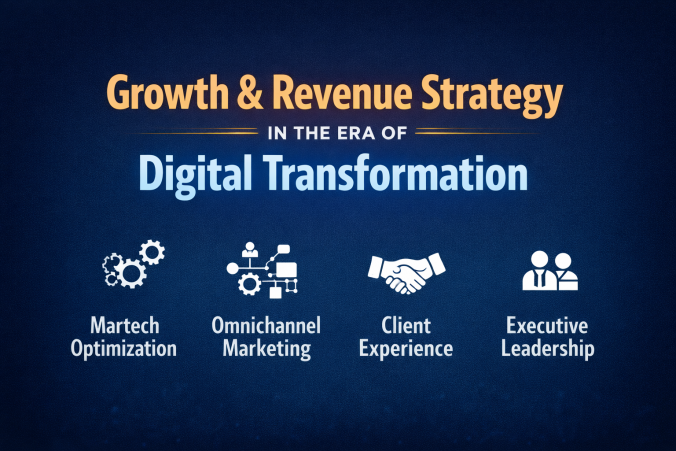
    Growth & Revenue Strategy in the Age of Digital Transformation

    How Leaders Align Martech, Omnichannel Marketing, and Client Experience for Scalable Growth

    In today’s competitive landscape, sustainable growth is no longer driven by isolated marketing campaigns or incremental technology upgrades. Organizations that win are those that align Growth & Revenue Strategy, Digital Transformation, and Client Experience Leadership into a single, accountable operating model.

    For executive teams, the challenge isn’t a lack of tools or data—it’s orchestrating people, platforms, and processes at enterprise scale while maintaining budget and P&L accountability. This is where modern marketing leadership has evolved from campaign execution to enterprise change leadership.

    Growth & Revenue Strategy Starts with Alignment, Not Tactics

    A strong Growth & Revenue Strategy begins by aligning business objectives with customer needs and operational reality. Too often, growth initiatives stall because strategy is defined in boardrooms but executed in silos.

    Effective leaders focus on:

    • Clear revenue ownership across marketing, sales, and service
    • Defined customer segments tied to measurable outcomes
    • Shared KPIs that connect pipeline growth, retention, and lifetime value

    Growth becomes predictable when strategy is translated into systems, behaviors, and incentives that reinforce one another.

    Digital Transformation Is a Business Strategy, Not a Technology Project

    Digital Transformation fails when it’s treated as a software rollout instead of an organizational shift. True transformation requires rethinking how teams work, how decisions are made, and how success is measured.

    High-performing organizations:

    • Design technology around business workflows, not vendor features
    • Prioritize data accessibility and decision velocity
    • Invest equally in change management and platform implementation

    Digital leaders understand that transformation is continuous—and that technology should enable smarter, faster execution across the enterprise.

    Martech Optimization: Turning Complexity into Competitive Advantage

    Modern marketing stacks are powerful, but only when optimized. Martech Optimization is the discipline of aligning platforms, data, and governance to support growth at scale.

    Key principles include:

    • Reducing redundancy across tools and vendors
    • Creating a single source of truth for customer data
    • Ensuring platforms support omnichannel execution and measurement

    When martech is optimized, teams spend less time managing tools and more time driving outcomes—improving both efficiency and ROI.

    Omnichannel Marketing as a Growth Engine

    Omnichannel Marketing is no longer optional. Customers expect consistent, relevant experiences across digital, physical, and human touchpoints.

    Leading organizations:

    • Integrate paid, owned, and earned channels into a unified journey
    • Use data to personalize experiences without sacrificing trust
    • Measure success across the full lifecycle, not isolated channels

    Omnichannel maturity directly impacts acquisition efficiency, retention, and brand perception—making it a core lever of growth strategy.

    Client Experience Leadership Drives Long-Term Value

    Growth isn’t just about acquiring customers—it’s about keeping them. Client Experience Leadership ensures that brand promises are consistently delivered across every interaction.

    Strong CX leaders:

    • Align marketing, sales, service, and operations around client outcomes
    • Use feedback loops to continuously improve experiences
    • Tie experience metrics to financial performance

    Organizations that lead with experience outperform peers in loyalty, advocacy, and lifetime value.

    Brand & Market Expansion Requires Discipline and Focus

    Successful Brand & Market Expansion isn’t about being everywhere—it’s about being relevant where it matters most.

    Expansion strategies should be grounded in:

    • Market and competitive analysis
    • Clear brand positioning and differentiation
    • Scalable operating models that protect margin

    Brand growth accelerates when expansion is intentional, data-driven, and operationally sound.

    Executive Team Leadership and P&L Accountability

    Modern marketing and digital leaders are expected to operate with full Budget & P&L Accountability. This requires financial fluency, prioritization, and the ability to make tradeoffs.

    Effective Executive Team Leadership includes:

    • Linking investment decisions to revenue impact
    • Managing budgets as strategic assets, not constraints
    • Communicating clearly with boards and stakeholders

    Leadership credibility is built when strategy, execution, and financial outcomes align.

    Enterprise Change Management Is the Differentiator

    The final—and often overlooked—component of success is Enterprise Change Management. Growth initiatives fail not because strategies are wrong, but because organizations aren’t prepared to change.

    Successful change leaders:

    • Communicate vision early and often
    • Engage teams across levels and functions
    • Measure adoption, not just implementation

    Change management turns strategy into sustained performance.

    Bringing It All Together

    Sustainable growth happens at the intersection of Growth & Revenue Strategy, Digital Transformation, and Client Experience Leadership—enabled by Martech Optimization, Omnichannel Marketing, and disciplined Executive Team Leadership.

    Organizations that master this alignment don’t just grow faster—they build resilience, relevance, and long-term value.

    Why the Future CMO is Really a Chief Growth Officer

    Introduction: The CMO at a Crossroads

    For years, the Chief Marketing Officer (CMO) was considered the “voice of the brand.” They oversaw advertising, managed creative agencies, and measured success in impressions, awareness, and share of voice.

    But the world has changed.

    Today, boards and CEOs are asking very different questions:

    • How much new revenue is marketing driving?
    • How effectively is marketing retaining customers?
    • How is marketing leveraging digital transformation to increase efficiency?

    The modern CMO is no longer judged by brand campaigns or vanity metrics. They’re judged by growth.

    In fact, in many organizations, the CMO role is quietly being redefined into something else entirely: the Chief Growth Officer (CGO).

    This article explores why the shift is happening, what it means for executives and boards, and how marketing leaders must evolve to remain relevant in the next decade.


    The Old CMO is Obsolete

    The traditional CMO job description revolved around three responsibilities:

    1. Managing brand and creative agencies
    2. Overseeing media spend and advertising
    3. Reporting campaign outcomes in marketing KPIs

    This approach worked in an era when TV ads, print media, and direct mail drove results. But digital transformation disrupted everything:

    • Customers moved online, expecting seamless, personalized experiences.
    • Marketing technology (martech) exploded, demanding technical fluency.
    • Boards grew less tolerant of “soft” metrics and demanded measurable ROI.

    The result? Many CMOs found themselves boxed in — seen as cost centers rather than growth drivers. A 2023 study by Spencer Stuart revealed the average CMO tenure is now the shortest of all C-suite roles.

    Boards aren’t firing CMOs because marketing is less important. They’re firing them because growth is more important than brand management.

    If the old CMO was a storyteller, the new CMO must be a strategist, technologist, and growth architect.


    The Shift to Growth Ownership

    The CMO’s evolution into the CGO isn’t just a cosmetic title change. It reflects a profound shift in responsibility and accountability.

    Modern marketing leaders are now judged on:

    • Revenue growth: Marketing must show direct impact on sales, not just leads.
    • Customer acquisition and retention: CAC (Customer Acquisition Cost) and LTV (Lifetime Value) are as important as impressions.
    • Cross-sell and upsell performance: Driving growth across existing customers, not just net new.
    • Digital efficiency: Using data and automation to do more with less.

    In my own experience leading a financial institution’s brand transformation, aligning marketing and client experience produced a 15% increase in retention and $30M in new revenue.

    At Bath Fitter, an integrated marketing and technology strategy fueled 40% lead growth, a 15% lift in conversions, and 25% YoY revenue growth.

    These aren’t just marketing metrics — they’re business outcomes.

    The lesson is clear: the marketing leader of the future doesn’t “own the brand.” They own the number.


    Growth = Cross-Functional Leadership

    Here’s the critical insight: growth doesn’t live in the marketing silo.

    It happens at the intersections of:

    • Marketing + Sales → Alignment around customer acquisition and retention
    • Marketing + IT → Martech, automation, data integration
    • Marketing + Operations → Efficiency gains, CX delivery
    • Marketing + Finance → Budgeting, ROI tracking, shareholder value

    The modern CMO/CGO is less a “department head” and more a bridge builder across the enterprise.

    At Bath Fitter, I led both marketing and IT — an unusual combination that produced breakthroughs in employee engagement and cost reduction.

    At a bank, I oversee both marketing and client experience — uniting brand strategy with CX to directly influence retention and growth.

    This dual-focus leadership is the blueprint for the future: CMOs who transcend silos and drive transformation across the enterprise.


    Why Private Equity and Fortune 1000 Firms Need CGOs

    Private equity (PE) firms and Fortune 1000 companies are under immense pressure:

    • PE firms need to accelerate value creation in short time frames.
    • Public companies face shareholder scrutiny for quarterly results.

    Both scenarios demand leaders who can unlock growth quickly and sustainably.

    Yet too often, marketing in these environments is underleveraged:

    • Seen as “cost” rather than “investment.”
    • Fragmented across too many tools, agencies, and initiatives.
    • Understaffed with the wrong skill sets (creative-heavy, analytics-light).

    The right CMO/CGO changes that equation.

    In a PE-backed company, I reduced marketing costs by 15% through martech consolidation and smarter processes, while simultaneously delivering 25% year-over-year revenue growth.

    That kind of dual impact — growth + efficiency — is exactly what PE firms and Fortune 1000 boards are hungry for.


    The Roadmap for the Modern CMO → CGO

    So how does a marketing leader make the leap from CMO to CGO? It requires a fundamental mindset shift and a new set of skills.

    1. Revenue Accountability

    • Tie every initiative back to revenue or retention.
    • Speak in the language of CFOs and CEOs — not “reach” but “ROI.”

    2. Martech & Data Fluency

    • Understand the stack: CRM, CDP, automation, analytics, AI.
    • Evaluate tools not as shiny objects but as growth enablers.

    3. Cross-Functional Leadership

    • Build coalitions with IT, Finance, Operations, and Sales.
    • Demonstrate influence beyond marketing.

    4. Customer-Centric Strategy

    • Treat CX not as a support function but as the core of growth.
    • Remove friction, design seamless experiences, and measure retention as closely as acquisition.

    5. Boardroom Presence

    • Position marketing as an enterprise lever, not a silo.
    • Educate boards and PE partners on how marketing drives shareholder value.

    AI and the Next Wave of Growth

    No discussion of the future CMO would be complete without addressing AI.

    AI isn’t replacing marketing leaders. But marketing leaders who master AI will replace those who don’t.

    Applications include:

    • Hyper-personalization at scale
    • Predictive analytics for churn reduction
    • Automated campaign optimization
    • Chatbots and self-service CX improvements

    The challenge is governance: how do you leverage AI without compromising data ethics, customer trust, or brand reputation?

    This is where the CGO lens is essential. AI must be deployed not as a gadget, but as a strategic enabler of sustainable growth.


    Implications for Boards and CEOs

    Boards and CEOs must ask themselves: Do we have a marketing leader, or do we have a growth leader?

    If you only have a marketing leader, you may be missing the engine that drives revenue and enterprise transformation.

    The implications are clear:

    • Boards should recruit CMOs with proven revenue impact, not just brand pedigree.
    • CEOs should expect their CMOs to be enterprise leaders who bridge marketing, IT, CX, and operations.
    • PE firms should view marketing as a growth accelerator in portfolio companies, not a line-item expense.

    Conclusion: The Future Belongs to Growth Architects

    The title “Chief Marketing Officer” may remain, but its mandate is rapidly disappearing.

    The future belongs to growth architects — executives who combine brand strategy, digital transformation, martech fluency, and cross-functional leadership to deliver measurable enterprise value.

    The companies that recognize this shift will outpace their competitors.
    The leaders who embrace this role will future-proof their careers and earn their place at the boardroom table.

    In short: the future CMO is really the Chief Growth Officer.

    © 2025 John Moss

    Theme by Anders NorenUp ↑