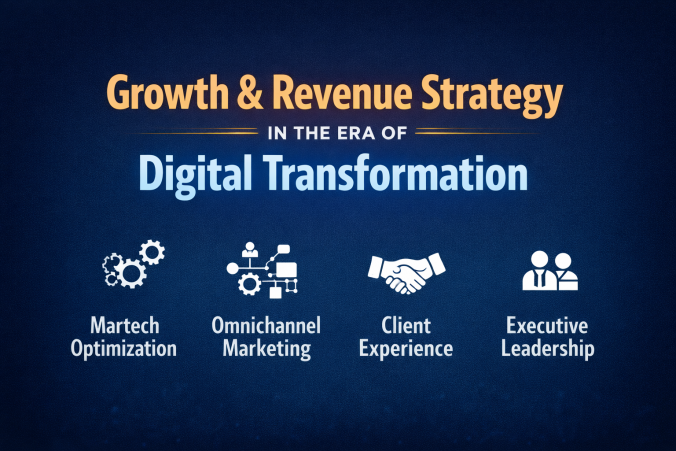
How Leaders Align Martech, Omnichannel Marketing, and Client Experience for Scalable Growth
In today’s competitive landscape, sustainable growth is no longer driven by isolated marketing campaigns or incremental technology upgrades. Organizations that win are those that align Growth & Revenue Strategy, Digital Transformation, and Client Experience Leadership into a single, accountable operating model.
For executive teams, the challenge isn’t a lack of tools or data—it’s orchestrating people, platforms, and processes at enterprise scale while maintaining budget and P&L accountability. This is where modern marketing leadership has evolved from campaign execution to enterprise change leadership.
Growth & Revenue Strategy Starts with Alignment, Not Tactics
A strong Growth & Revenue Strategy begins by aligning business objectives with customer needs and operational reality. Too often, growth initiatives stall because strategy is defined in boardrooms but executed in silos.
Effective leaders focus on:
- Clear revenue ownership across marketing, sales, and service
- Defined customer segments tied to measurable outcomes
- Shared KPIs that connect pipeline growth, retention, and lifetime value
Growth becomes predictable when strategy is translated into systems, behaviors, and incentives that reinforce one another.
Digital Transformation Is a Business Strategy, Not a Technology Project
Digital Transformation fails when it’s treated as a software rollout instead of an organizational shift. True transformation requires rethinking how teams work, how decisions are made, and how success is measured.
High-performing organizations:
- Design technology around business workflows, not vendor features
- Prioritize data accessibility and decision velocity
- Invest equally in change management and platform implementation
Digital leaders understand that transformation is continuous—and that technology should enable smarter, faster execution across the enterprise.
Martech Optimization: Turning Complexity into Competitive Advantage
Modern marketing stacks are powerful, but only when optimized. Martech Optimization is the discipline of aligning platforms, data, and governance to support growth at scale.
Key principles include:
- Reducing redundancy across tools and vendors
- Creating a single source of truth for customer data
- Ensuring platforms support omnichannel execution and measurement
When martech is optimized, teams spend less time managing tools and more time driving outcomes—improving both efficiency and ROI.
Omnichannel Marketing as a Growth Engine
Omnichannel Marketing is no longer optional. Customers expect consistent, relevant experiences across digital, physical, and human touchpoints.
Leading organizations:
- Integrate paid, owned, and earned channels into a unified journey
- Use data to personalize experiences without sacrificing trust
- Measure success across the full lifecycle, not isolated channels
Omnichannel maturity directly impacts acquisition efficiency, retention, and brand perception—making it a core lever of growth strategy.
Client Experience Leadership Drives Long-Term Value
Growth isn’t just about acquiring customers—it’s about keeping them. Client Experience Leadership ensures that brand promises are consistently delivered across every interaction.
Strong CX leaders:
- Align marketing, sales, service, and operations around client outcomes
- Use feedback loops to continuously improve experiences
- Tie experience metrics to financial performance
Organizations that lead with experience outperform peers in loyalty, advocacy, and lifetime value.
Brand & Market Expansion Requires Discipline and Focus
Successful Brand & Market Expansion isn’t about being everywhere—it’s about being relevant where it matters most.
Expansion strategies should be grounded in:
- Market and competitive analysis
- Clear brand positioning and differentiation
- Scalable operating models that protect margin
Brand growth accelerates when expansion is intentional, data-driven, and operationally sound.
Executive Team Leadership and P&L Accountability
Modern marketing and digital leaders are expected to operate with full Budget & P&L Accountability. This requires financial fluency, prioritization, and the ability to make tradeoffs.
Effective Executive Team Leadership includes:
- Linking investment decisions to revenue impact
- Managing budgets as strategic assets, not constraints
- Communicating clearly with boards and stakeholders
Leadership credibility is built when strategy, execution, and financial outcomes align.
Enterprise Change Management Is the Differentiator
The final—and often overlooked—component of success is Enterprise Change Management. Growth initiatives fail not because strategies are wrong, but because organizations aren’t prepared to change.
Successful change leaders:
- Communicate vision early and often
- Engage teams across levels and functions
- Measure adoption, not just implementation
Change management turns strategy into sustained performance.
Bringing It All Together
Sustainable growth happens at the intersection of Growth & Revenue Strategy, Digital Transformation, and Client Experience Leadership—enabled by Martech Optimization, Omnichannel Marketing, and disciplined Executive Team Leadership.
Organizations that master this alignment don’t just grow faster—they build resilience, relevance, and long-term value.

Leave a Reply